
Author: Jun De Leon MD MBAH
Peer Reviewer: Mac Cueto RMT MD MSAHP
In every Filipino home, food is more than a meal — it is an expression of culture and familial values. From pancit cooked on birthdays to adobo simmering on weekends, each dish carries the warmth of belongingness, the spirit of celebration, and the expression of loving and care. To feed someone is to show affection, to share one’s blessings, and to say, “You belong here.”
Across different provinces and spanning generations, this culture of food as love has defined families together. Guests are welcomed with open tables, save food for someone who arrives late, and cook enough to share with the whole neighborhood. These small acts of generosity reflect deeper values — hospitality, respect, and sacrifice — the same virtues that define Filipino family life itself.
But in today’s changing world, these beautiful traditions face new challenges. The love that drives us to feed others abundantly can, in modern times, also lead us to eat beyond what our bodies need. The same convenience that once symbolized progress — instant noodles, fast food, and sugary drinks — has quietly reshaped how we nourish ourselves.
Around the world, nutrition is at a crossroads. While hunger and undernutrition persist, overweight and obesity are rising sharply — even among children. Many countries, including the Philippines, now live with both extremes: families that struggle with scarcity and others facing diseases born from excess. The table that once united us in celebration is now linked, more than ever, to chronic conditions like diabetes, heart disease, and fatty liver.
Yet our food culture also holds the key to healing. Filipino traditions have always centered on “pakikipagkapwa,” — seeing others as part of oneself. True hospitality is not only feeding people generously, but feeding them well. Respect for our elders can mean protecting their health through mindful meals. Sacrifice, once shown through long hours of work, can now mean taking time to cook fresh food instead of settling for what’s easy.
To rethink how we eat is not to rescind who we are. It is to return to the essence of why we eat together — to nourish, to celebrate life, and to care for one another. Our favorite dishes need not disappear; they can simply evolve. Less salt in the adobo, more vegetables on the pancit, a little less sugar in the dessert — these small changes honor both our heritage and our health.
Let’s review a study done in the US on how successful using those traditions can be in combating a common Filipino health issue: hypertension! Filipino Americans have one of the highest rates of hypertension among Asian American groups, yet most dietary programs fail to consider their food culture. A pilot study from the University of California, Berkeley, tested a new approach: a culturally-tailored, heart-healthy Filipino cookbook designed using principles of culinary medicine and community participation.
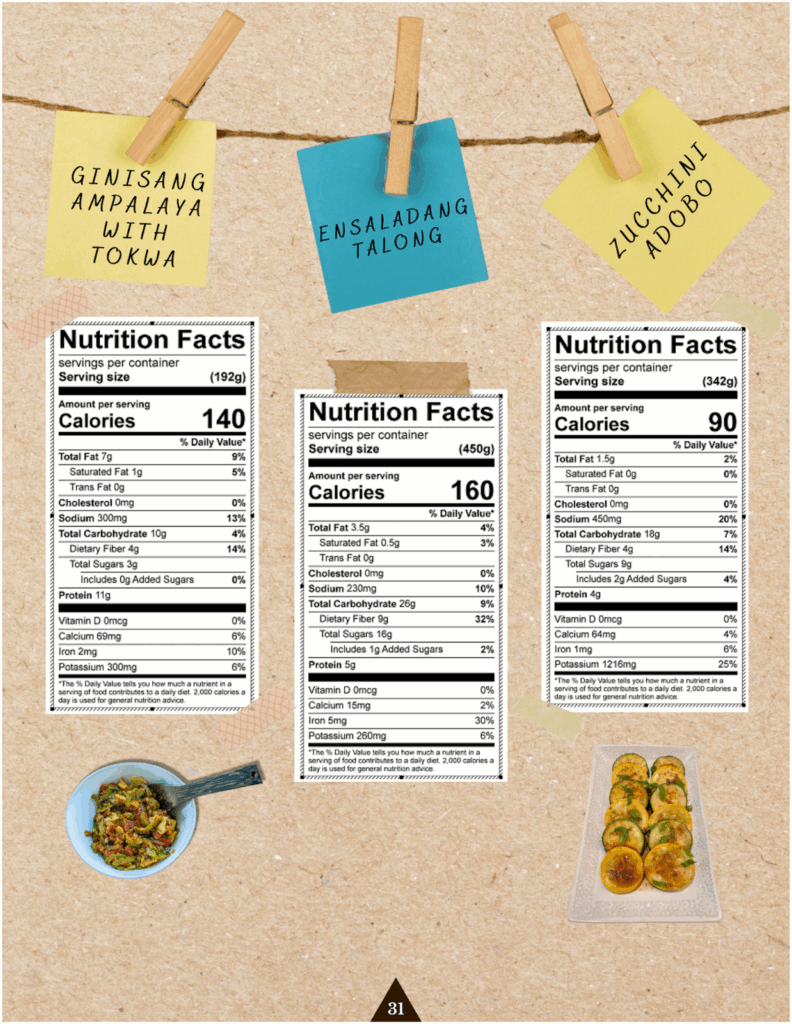
Researchers collaborated with five Filipino culinary experts and a registered dietitian to adapt traditional dishes—reducing sodium, fat, and refined carbohydrates while keeping familiar flavors (see Figure 1 for sample nutrition facts). The cookbook blended recipes, nutrient information, and personal stories that emphasized heritage, connection, and health. Twenty adults with physician-diagnosed hypertension were recruited from Filipino community organizations and asked to use the cookbook and prepare at least one recipe over three weeks.
The results showed strong acceptance and meaningful behavioral shifts. Participants described the cookbook as empowering and relatable, noting that its storytelling and visuals made healthy cooking enjoyable rather than restrictive. Average self-care management scores for blood-pressure control improved significantly—from 63.8 percent to 80.8 percent (p < 0.008). Many participants reported greater motivation to cook low-salt meals, eat more fruits and vegetables, and continue dietary changes beyond the study period.
The findings suggest that culturally-competent nutrition tools can successfully bridge medical advice and cultural identity, transforming “healthy eating” from an imposed rule into an act of self-care and community care. Although the study was centered on hypertension, the same principles can also be applied to help control chronic non-communicable diseases like obesity, diabetes, and fatty liver.
The heart of Filipino food culture has always been Kapwa, often expressed through loving care — the same care that lifestyle medicine now seeks to restore in modern living. Around the world, experts are rediscovering what our ancestors already knew: health begins with everyday choices.
Lifestyle medicine focuses on small, doable, and practical habits that protect the body and sustain wellbeing — eating mostly whole, natural foods, staying active, resting well, managing stress, avoiding harmful habits, and keeping strong social ties. These are simple acts of care that echo our traditions of Kkapwa and hospitality.
In a time when chronic diseases like hypertension, diabetes, fatty liver, osteoarthritis, and heart ailments are on the rise, these habits offer quiet but lasting healing. Even small steps — lighter portions, evening walks, or taking time to rest — can help bring balance back to our lives. For some, nutritional supplements such as Essentiale and Hepastrong (for strengthening the liver), Genecol and Artroveron (for joint health and mobility), Focumax and Eyevite (for clear vision), Immunomax and Immunoglucan (for boosting immune defense), Ginkgo biloba and Sole Max (for enhancement of mental focus), and Stresstabs and Stresnol (for stress relief may help too, but they work best when practicing the lifestyle medicine principles.
As we celebrate another season of abundance, perhaps this is what “Kumain na tayo” should mean today — not only “let’s eat,” but “let’s live well.” Each meal, each shared moment, becomes a chance to practice care — for our families, our communities, and our future health.
References:
Khan, B. (2025). The Role of Lifestyle Interventions in Preventing and Managing Non-Communicable Diseases. Non-Communicable Diseases and Care, 2(1), 50-60.
Negrillo, Aaron, “Kumain Na Tayo! Exploring the Role of Food in Communicating Tradition and Instilling Familial Values” (2019). Student Research. 1.
https://knowledge.e.southern.edu/jour_studentresearch/1
Sijangga, M. O., Pack, D. V., Yokota, N. O., Vien, M. H., Dryland, A. D., & Ivey, S. L. (2023). Culturally-tailored cookbook for promoting positive dietary change among hypertensive Filipino Americans: a pilot study. Frontiers in nutrition, 10, 1114919.